2007 POSTS SELF-UNIVERSITY
NEWSLETTER & ANNOUNCEMENTS: Committed to lifelong learning as the lifeblood of
democracy and the key to living life to its fullest. Dedicated to
furthering education not as something you get but as something you
take.
I've added some new works to
Book Worth Reading below. John F. Schumaker's In Search of
Happiness is still included for two reasons. The first is
that it sold out quickly and in the shuffle for a new printing it
keeps acquiring new pub dates. In
Search of Happiness is available for pre-order from Amazon. To order a copy
click on the book graphic below.
Charles D. Hayes
Books Worth Reading:
In Search of
Happiness: The History of an Endangered State of Mind,
by John F. Schumaker
One of my favorite authors
on the planet has a new book just released on the subject
of happiness. Schumaker is one of the most articulate observers
of the human condition I’ve yet discovered. I received an advance
copy and I've read it twice. If the subject of happiness is
important to you, then you may want to do likewise.
Schumaker makes references occasionally about his affection for
the big picture. In my view, he paints the big picture
thoroughly. Here is a sample from the book:
“We
live in a world that predisposes people to be depressed,
stressed, materialistic, discontented, greedy,
overly-complicated, narcissistic, uncompassionate, bored and
indifferent, fearful, lonely, rageful, spiritually starved,
under-touched, play deprived, dance deprived, sleep deprived,
intellectually dull, divorced from curiosity and creatively,
removed from nature, desperate for intimacy, adrift from friends
and family, existentially confused, physically unfit, and
enslaved to debt. Almost every aspect of the modern way of life
diminishes our chances of a worthwhile and meaningful
happiness."
Schumaker is unsurpassed
in synthesizing the things that really matter in terms that one
can readily relate to. On the back cover is the statement: "This
is a book about the thing that everybody wants." The trouble,
as Schumaker makes clear, is that most people do not know what it
is that they seek or nor would they likely recognize happiness if the
found it. Without a serious effort to understand the genealogy
of happiness, too many of us miss the whole point of what it
means to be happy.
In this book, Schumaker
traces the history of happiness from its prehistoric origins to
its current super-commercialized form in an age of mass
consumerism and epidemic depression. Drawing on the
sciences and the arts, Schumaker constructs a new definition of
a much-used but poorly understood term.
The result is startling and
ultimately inspiring-a highly readable blueprint for seeking and
finding genuine happiness, both as individuals and as a society.
Highly recommended.
From the dust jacket: "Far more than we
are consciously aware, our daily encounters with parents,
spouses, bosses, and even strangers shape our brains and affect
cells throughout our bodies--down to the level of our genes--for
good or ill. In Social Intelligence,
Goleman explores an emerging
new science with startling implications for our interpersonal
world. It's most fundamental discovery: we are designed for
sociability, constantly engaged in a 'neural ballet' that
connects us brain to brain with those around us.
Our reactions to others, and theirs to us, have a
far-reaching biological impact, sending out cascades of hormones
that regulate everything from our hearts to our immune systems,
making good relationships act like vitamins--and bad
relationships like poisons. We 'catch' other people's emotions
the way we catch a cold."
Highly recommended.
From the dust jacket: "A preeminent scientist -- and
the world's most prominent atheist -- asserts the irrationality
of belief in God and the grievous harm religion has inflicted on
society, from the Crusades to 9/11. With rigor and wit, Dawkins
examines God in all his forms, from the sex-obsessed tyrant of
the Old Testament to the more benign (but still illogical)
Celestial Watchmaker favored by some Enlightenment thinkers. He
eviscerates the major arguments for religion and demonstrates
the supreme improbability of a supreme being. He shows how
religion fuels war, foments bigotry, and abuses children,
buttressing his points with historical and contemporary
evidence. The God Delusion makes a compelling case
that belief in God is not just wrong but potentially deadly. It
also offers exhilarating insight into the advantages of atheism
to the individual and society, not the least of which is a
clearer, truer appreciation of the universe's wonders that any
faith could ever muster."
Highly recommended.
From the dust jacket: "The rise of the 'information
society' offers not only considerable peril but also great
promise. Beset from all sides by a never-ending barrage of
media, how can we ensure that the most accurate information
emerges and is heeded? In this book, Cass R. Sunstein develops a
deeply optimistic understanding of the human potential to pool
information, and to use that knowledge to improve our lives.
In an age of information overload, it is easy
to fall back on our own prejudices and insulate ourselves with
comforting opinions that reaffirm our core beliefs. Crowds
quickly become mobs. The justification for the Iraq war, the
collapse of Enron, the explosion of the space shuttle
Columbia--all of these resulted from decisions made by leaders
and groups trapped in 'information cocoons,' shielded from
information at odds with their preconceptions."
Highly recommended.
From the dust jacket: "After George Bush's stunning
re-election in 2004, newspaper headlines such as 'Rural Values
Proved Pivotal' summed up the story, and the outcome left tens
of millions of urban Americans baffled and outraged.
America's political divide is not between red states and blue
states. The divide is between co
unties
in every state in the nation, and this urban-rural schism is the
new frontier in America's culture war.
Highly recommended.
From the dust jacket: "Race, ethnicity, nationality,
religion, gender, sexuality: in the past couple of
decades, a great deal of attention has been paid to such
collective identities. They clamor for recognition and
respect, sometimes at the expense of other things we value. But
to what extent do 'identities' constrain our freedom, our
ability to make an individual life, and to what extent do they
enable our individuality? In this beautifully written work,
renowned philosopher and African Studies scholar Kwame Anthony
Appiah draws on thinkers through the ages and across the globe
to explore such questions.
The
Ethics of Identity takes seriously both the claims of
individuality--the task of making a life--and the claims of
identity, these large and often abstract social categories
through which we define ourselves."
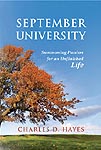
I have a new book in progress, September University: Rediscover the Wonder of Existence and
Help Change the World. I'm also starting a new discussion
group Sept-U. The purpose is to discuss the things that really matter in the fall and winter of life with an
emphasis on arriving at the better argument and with a positive effect
on posterity.
Sign up to participate as a member of September University.